Your cart is empty.


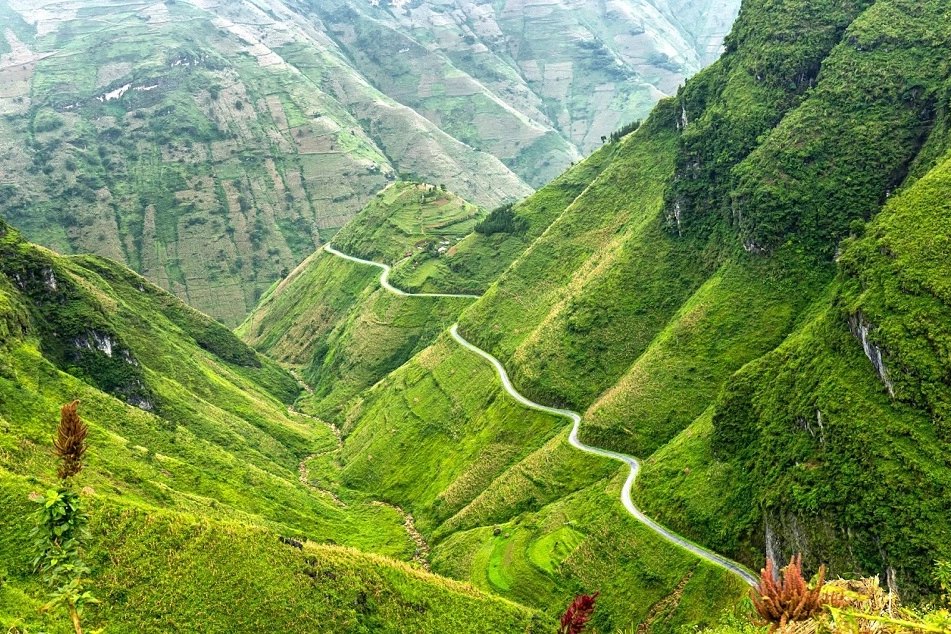
Ask ten travellers how many days you need for the Ha Giang Loop and you will get ten different answers. Some swear the loop can be done in two days. Others tell you they stayed a week and still cried when they left. After guiding hundreds of riders through these mountains, we can tell you the honest answer: it depends on how you travel — but for most people, the sweet spot is clearer than you think.
This guide breaks down exactly how many days to spend on the Ha Giang Loop, what you gain (and lose) with each option, and how the rainy season changes the maths.
There is a saying among riders here: almost everyone who completes the 3-day loop wishes they had added an extra day. Almost nobody who rode 4 days wishes they had done 3.

The Ha Giang Loop is a circuit of roughly 350 km through the far north of Vietnam, crossing the Dong Van Karst Plateau UNESCO Global Geopark — Quan Ba, Yen Minh, Dong Van, the Ma Pi Leng Pass and Meo Vac. The distance never changes. What changes with how many days you choose is the pace: how early you start, how long you sit on the bike, and how many places you pass without stopping.
If you are completely new to the region, start with our Ultimate Ha Giang Loop Guide for the full picture of routes, costs and tips.
A 2-day loop is possible — we run it for travellers who genuinely cannot spare more time. You will see Quan Ba Heaven’s Gate, the Tham Ma Pass and a shortened northern section. But be honest with yourself about what this is: long riding hours, quick photo stops, and no time for the boat ride on the Nho Que River or the villages beyond the main road.
Choose 2 days only if the alternative is not coming to Ha Giang at all.
Three days is what most first-timers book, and it works: you complete the full loop and stand on the Ma Pi Leng Pass with time for the highlights. The trade-off is the pace — expect 5–6 hours of riding per day, with Day 2 being especially long. When travellers ask us how many days they need to “see the loop”, we say honestly: three is enough to see it. Four is enough to feel it.
Wondering how many days most guides themselves would choose? Four. The riding drops to a relaxed 4–5 hours per day, and the extra day adds the places that make the plateau special:
Four days also spreads the physical load. Mountain riding is tiring even as a passenger, and an easier daily rhythm means you arrive at each viewpoint actually enjoying it.

With five days you can either slow the classic loop down even further — more village time, more hikes — or extend the journey east towards Cao Bang and Ban Gioc Waterfall for a completely different landscape of rivers and waterfalls. This is the option for travellers who know that northern Vietnam is the highlight of their trip.
Almost everyone who asks us how many days they need has already narrowed it to two options, so let us put 3 days vs 4 days side by side properly.
The difference is not distance — both cover the same loop. It is hours on the bike per day. On 3 days, two of your days run roughly 150 km, which is five to six hours riding with quick stops. On 4 days that same ground is split into four gentler days of four to five hours, and the extra night in Yen Minh is what turns the Lung Cu and Lo Lo Chai stretch from a rush into a real day.
So the honest 3 days vs 4 days answer is: 4 days is the better ride, 3 days is often the better trip. Most travellers have two to four weeks for a country 1,650 km long. Ha Giang realistically eats five to six days door to door from Hanoi once the night buses are counted. A fourth day here is wonderful — it is also a day not spent in Ninh Binh or Hoi An.
Two things that do not change either way: the border area permit is required for foreign travellers and charged per person per province (we pass it through at cost, no markup), and our Classic departures are capped at six riders whatever the length — on Ma Pi Leng the difference between six bikes and twenty-five is not subtle.
From June to September, afternoon downpours and morning fog are part of the deal. This changes the answer to how many days you should plan: add a buffer. On a 3-day schedule, if the Ma Pi Leng Pass is buried in fog on your only morning there, that is simply bad luck. On a 4-day schedule, your guide can flip the plan — ride early, rest in the afternoon, catch the view the next morning. The extra day is not a luxury in wet season; it is insurance for the exact views you came for.
If you are coming in flower season, how many days you need shifts — and most guides currently get the dates wrong.
The provincial plan for the 12th Buckwheat Flower Festival (Plan No. 301/KH-UBND, issued 3 August 2026) sets the blooming window from October through the end of December, with 400 hectares sown in three staggered waves so the bloom carries across all three months. Thirteen locations along the route are required to plant display beds, including Tham Ma Pass, the road into Pao’s House, Lo Lo Chai and the Nho Que pier. The opening ceremony is on 6 November in Dong Van.
That gives you a clear rule for how many days to plan:
One more line from the plan worth knowing: inspectors are instructed to secure commitments from accommodation and restaurants not to raise prices during the festival.
Yes, but it is a highlights express with long riding hours. If two days is all you have, an Easy Rider makes it far more enjoyable — you rest while a local handles the mountain roads.
Three days covers the full circuit and the main viewpoints at a brisk pace. It is enough for the classic experience — just know that the most common feedback we hear is “I wish I had booked the extra day.”
Shorter riding hours, an evening in Dong Van Old Quarter, the Nho Que boat ride, Lung Cu Flag Tower, and a weather buffer in the wet months. Same loop, better experience.
Five days minimum. Our 5-day route links the Ha Giang Loop with Cao Bang and Ban Gioc in one journey.
Whichever length you choose, Ali Travel runs the loop in small groups of maximum 10 riders — 2, 3, 4 and 5-day options, self-riding or with local Easy Riders, from $125 per person with free cancellation up to 24 hours before departure. Tell us how many days you have and we will make every one of them count.
Contact us on WhatsApp/Zalo at (+84) 787 652 333 or email info@hagiangalitravel.com. For official travel information about Vietnam, see vietnam.travel.
If you would rather ride it with someone who knows the road, these are the tours we run ourselves.
Dong Van & Ma Pi Leng3 days 2 nightsSee dates & prices →Deep Loop – Du Gia Waterfall4 days 3 nightsSee dates & prices →
Free cancellation up to 24 hours before departure — 100% refund, deposit included.