Your cart is empty.


Every traveller planning northern Vietnam hits the same fork in the road: the Ha Giang vs Sapa question. Both are mountain regions, both promise rice terraces and ethnic-minority culture, and most itineraries only have room for one. We run tours in Ha Giang, so you know where our heart is — but we have sent plenty of guests to Sapa too, and the honest answer to Ha Giang vs Sapa depends on the kind of trip you want.
Here is the comparison we give our own friends, with no marketing gloss.
| Sapa | Ha Giang | |
|---|---|---|
| Best for | Organised trekking, cable-car convenience, cool café towns | Raw limestone landscapes, a motorbike road trip across the Dong Van Karst Plateau |
| Transfer from Hanoi | ~5–6 hours by road, or overnight train to Lao Cai | ~6–7 hours by sleeper bus (250,000 VND) or limousine cabin |
| Permit for foreigners | Not required | Required in border districts — ~$10 |
| Time you really need | Works for a short trip | Minimum 3–4 days — the loop cannot be rushed |
| Crowds | Busy, well-developed tourist town | Far fewer tourists |
| Village life | Often performed for visitors | Villages that do not perform for visitors |
| Doing both | Opposite sides of northern Vietnam — allow 6–8 days | Most travellers ride Ha Giang first, then transfer west |
Sapa’s beauty is soft and green: the Muong Hoa valley’s sculpted rice terraces, misty peaks, and Fansipan — the highest mountain in Indochina, reachable by cable car. It is stunning, and it photographs like a postcard.
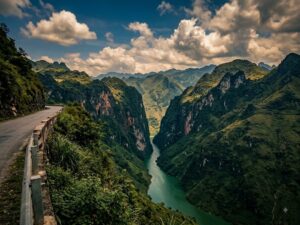
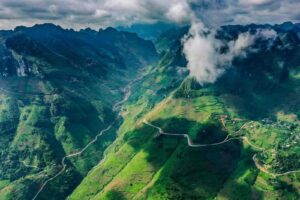
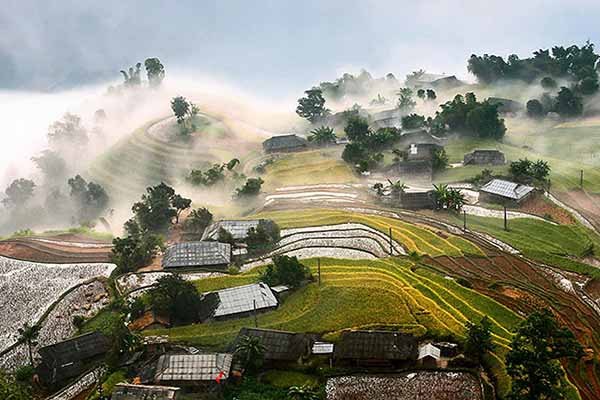
Ha Giang’s beauty is dramatic and vertical. The Dong Van Karst Plateau is a UNESCO Global Geopark (see unesco.org) of grey limestone pinnacles, canyon roads, and the Ma Pi Leng Pass above the emerald Nho Que River — many riders call it the most spectacular road in Vietnam. And in Hoang Su Phi, on Ha Giang’s western side, you get golden terraced fields that rival anything in Sapa — with a fraction of the visitors.
If your dream photo is rice terraces, both deliver. If it is a ribbon of road hanging over a canyon, only one does.
This is where the two part ways hardest. Sapa has been northern Vietnam’s flagship destination for decades: the town is built for tourism, with hotels, spas, and persistent street selling. Treks can feel scheduled, and the famous viewpoints get busy.
Ha Giang still feels like the frontier. Markets in Dong Van and Meo Vac run for locals first; homestay dinners are family affairs; on many stretches of the loop your only company is the wind and the occasional water buffalo. Travellers consistently tell us the same thing: Ha Giang felt like the Vietnam they had imagined.
The practical difference: Sapa is a base you stay in; Ha Giang is a journey you move through. That journey takes days — see how many days you need for the Ha Giang Loop to plan it right. Note that foreign travellers in Ha Giang’s border districts need a $10 border permit (we handle the paperwork on tours).

The Ha Giang vs Sapa cost comparison is closer than most people expect. Both regions are inexpensive by Western standards; Sapa’s hotel scene skews slightly pricier, while Ha Giang’s costs concentrate in the bike or tour. For real numbers on the Ha Giang side — buses, rentals, permits, tours from $125 — see our full Ha Giang Loop cost breakdown.
This may be the deepest difference in the Ha Giang vs Sapa comparison. Sapa offers easy, organised access to Black H’Mong, Red Dao and Tay villages — genuinely interesting, but shaped by twenty years of daily tour groups. In Ha Giang, culture is simply everyday life: H’Mong farmers working corn fields between limestone teeth, the Black Lo Lo community of Lo Lo Chai below the Lung Cu flag tower, Sunday markets where trading matters more than tourists. Neither is “better” — but they feel very different to walk through.
Yes — they sit on opposite sides of northern Vietnam, and with 6–8 days you can link them (most travellers do Ha Giang first, then transfer west). If you only have time for one region and the ride itself excites you, our verdict in the Ha Giang vs Sapa choice is no secret: come ride the loop.

Sapa, for infrastructure: marked routes, guides everywhere, treks of every length. Ha Giang has beautiful walks (Hoang Su Phi, Du Gia), but it is first and foremost a road-trip destination.
Sapa is quicker to reach and works as a 2-day escape. Ha Giang deserves 3–4 days minimum — the loop cannot be rushed.
Significantly. Ha Giang’s visitor numbers have grown, but outside the main stops the loop remains quiet — especially midweek and in the green season.
To ride yourself, yes — a valid licence plus a 1968-Convention IDP. Without one, join an Easy Rider tour and ride passenger legally with a local driver.
Sapa is a lovely destination. Ha Giang is an adventure. If that word means something to you, you already know your answer — and we would love to show you why. Small groups (max 10), local Easy Riders, 2–5 day routes, free cancellation up to 24 hours.
WhatsApp/Zalo (+84) 787 652 333 · info@hagiangalitravel.com · hagiangalitravel.com
If you would rather ride it with someone who knows the road, these are the tours we run ourselves.
Dong Van & Ma Pi Leng3 days 2 nightsSee dates & prices →Deep Loop – Du Gia Waterfall4 days 3 nightsSee dates & prices →
Free cancellation up to 24 hours before departure — 100% refund, deposit included.