Your cart is empty.

Your cart is empty.

Your cart is empty.
Your cart is empty.
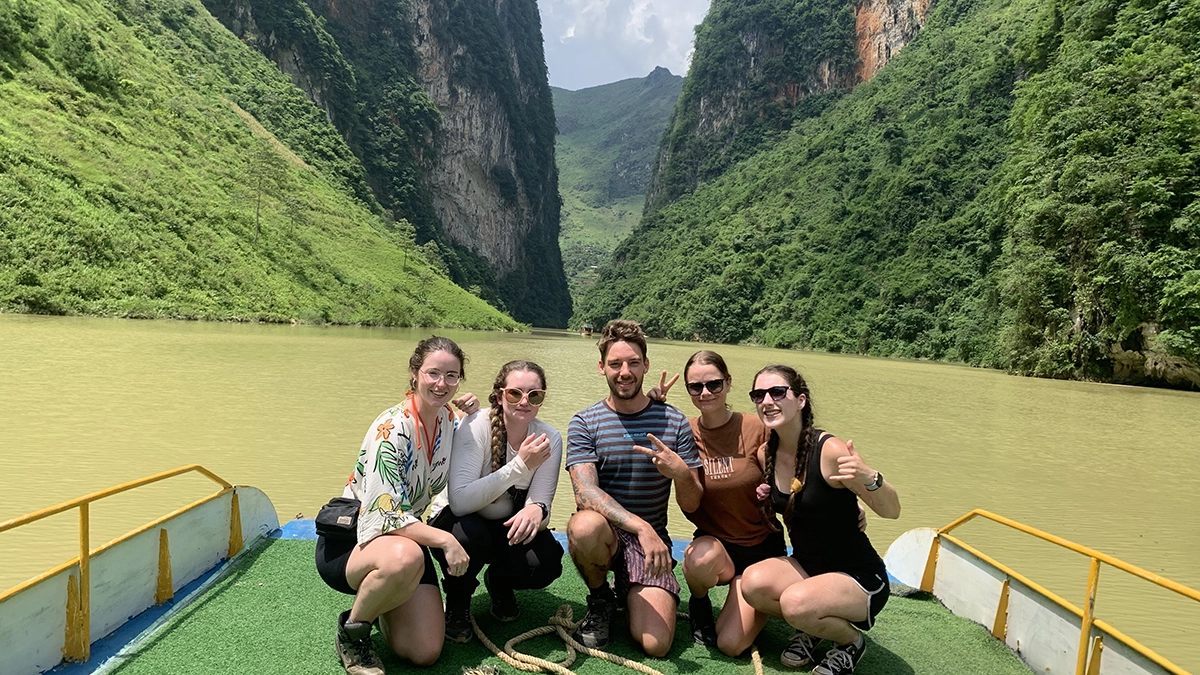
Among the countless natural wonders of Ha Giang, there is one place that never fails to leave travellers in awe — a place so grand, so mysterious, it feels almost surreal. That place is Tu San Canyon (Hẻm Tu Sản), widely described as one of the deepest canyons in Southeast Asia. More than just a destination for adventure seekers, Tu San is also one of Vietnam’s most incredible spots for photography — a towering slot of rock and water that seems designed to make you feel small in the best possible way.
Table of Contents
ToggleTu San Canyon lies between the famous Ma Pi Leng Pass and the emerald Nho Que River, in the Meo Vac area of Ha Giang, in Vietnam’s far north. With towering cliffs reaching several hundred metres high and stretching roughly 1.7 kilometres long, the canyon is carved dramatically between nearly vertical rock walls — a giant crack in the earth, embraced by endless mountains and forest.
The story behind Tu San is written in stone, quite literally. Over millions of years, the Nho Que River patiently sliced its way down through the limestone, carving a gorge so narrow and so deep that the sky above shrinks to a thin blue ribbon. This is limestone country at its most theatrical, part of the wider Dong Van Karst Plateau, a UNESCO Global Geopark whose rock formations date back tens of millions of years. Standing at the canyon’s edge, you are not just admiring a pretty view — you are looking at one of the most dramatic pieces of geological history anywhere in Ha Giang.
You can already glimpse the canyon’s grandeur from the top of Ma Pi Leng, but for the most stunning, immersive moments, nothing beats a boat ride along the Nho Que River, floating beneath the canyon walls and gazing skyward. It is a memory you will carry forever.
There is no single “right” way to see Tu San — the two classic approaches complement each other beautifully. If your schedule allows, do both: admire the canyon from above on the pass, then descend to the river and glide right into its heart.
If you are short on time or simply love a bird’s-eye view, you can capture incredible scenes from the top of Ma Pi Leng Pass, often called the “roof of Ha Giang.” Several roadside cafes and viewing platforms line the pass, each offering panoramic views of the canyon and the winding Nho Que River far below — like a painting brought to life. From up here, the river reveals its unreal jade colour and the sheer scale of the gorge becomes obvious in a way that photos rarely do justice.
The road that clings to Ma Pi Leng is itself one of the highlights of any trip through the region, so many travellers linger here for an hour or two, coffee in hand, watching the light shift across the cliffs. Take your time, walk between a couple of the viewpoints, and you will find the exact frame you came for.
To truly feel the scale of Tu San, you need to be on the water. From the boat docks near Ta Lang / Tu Tung on the way down from Ma Pi Leng, you can join a motorboat cruise or paddle your own kayak straight into the gorge. This is when the magic happens: the emerald river winds gently between colossal cliffs, sunbeams pierce through the narrow gaps, and the water reflects the light like a giant natural mirror.
The boat ride is gentle and suitable for most travellers, including families and older visitors, though the road down to the pier is steep and best left to an experienced local driver. As the boat slips into the narrowest section, everyone tends to fall silent — heads tilt back, cameras come out, and for a few unforgettable minutes it is just you, the water, and walls of rock rising hundreds of metres on either side.
Tu San is beautiful year-round, but the experience changes with the seasons. The dry months from roughly October to April usually bring clearer skies, calmer water and that signature emerald colour on the Nho Que River. The green season from late spring into summer drapes the surrounding mountains in lush vegetation, though occasional afternoon showers and mist can roll through. Whatever the month, mornings tend to be calmer and clearer, so an early start rewards you with both fewer crowds and softer light.
For photography, aim for the golden hours — early morning or late afternoon — when light and shadow dance across the rock walls in cinematic fashion. In the middle of the day the sun sits high and the deep canyon can fall into flat shadow, so the edges of the day are your friend. On the water, the low sun angling into the gorge creates the dramatic beams and reflections that make Tu San photos so striking.
A few poses have become classics at Tu San: standing at the tip of a boat with arms wide open as if embracing the mountains; facing away from the camera while gazing up at the towering cliffs; or a close-up of your hand skimming the glowing river surface. Each of these creates a powerful sense of scale and serenity that people scrolling past simply cannot ignore.
Tu San Canyon sits deep in the northeastern corner of Ha Giang, reached via the legendary Ha Giang Loop. Most travellers ride or are driven from Ha Giang city up through Yen Minh and Dong Van, then over Ma Pi Leng Pass toward Meo Vac — the same route that delivers the region’s most famous scenery. From the pass, a steep side road drops down to the Nho Que River boat piers, where the cruises depart.
You can do it independently on a motorbike, hire a private driver, or join an organised tour that handles the logistics for you. If it is your first time in the region, our ultimate Ha Giang Loop guide walks you through routes, costs and timing so you can slot Tu San in without stress. Whichever way you arrive, build in a little buffer — the descent to the river is slow, and you will want time on the water rather than rushing back up.
A few sensible precautions make the visit worry-free. The road down to the boat docks is narrow and steep, so if you are not a confident rider, let a local driver take the wheel for that final stretch. On the boat, wear the life jacket provided, keep phones and cameras secured with a strap, and follow the crew’s instructions. Near the viewpoints on Ma Pi Leng, stay behind the barriers — the drops are genuine and the edges can be loose.
Because Tu San sits right on the classic loop, it pairs naturally with the region’s other highlights. Spend time on Ma Pi Leng Pass itself, cruise the wider stretches of the Nho Que River, explore the karst towers and stone villages of the Dong Van Karst Plateau, and roll it all into a two- or three-day journey around the Ha Giang Loop. Seen together, they add up to one of the most spectacular road trips in Southeast Asia.
Tu San Canyon is not only a geological wonder — it is a dreamland for anyone drawn to wild beauty and untouched landscapes. Whether you are a professional photographer or a casual traveller looking to capture unforgettable moments, this place offers once-in-a-lifetime frames you will not find anywhere else. And perhaps, as you drift through the gorge and look up at the sky framed by vertical cliffs, you will understand that in Ha Giang, nature truly is the greatest artist of all.
Ready to stand beneath those towering walls and glide down the emerald Nho Que River? Let the local team at Ha Giang Ali Travel handle the driving, the boat tickets and the timing so you can focus on the view. We will help you build a Ha Giang Loop itinerary that puts Tu San Canyon, Ma Pi Leng Pass and the Dong Van Karst Plateau in the right order, at the right time of day, for the best light and the fewest crowds. Message us any time and we will tailor a trip to you.
WhatsApp / Zalo: (+84) 787 652 333 | info@hagiangalitravel.com | hagiangalitravel.com
See more:
This is the centrepiece of every tour we run — with time to stop at the viewpoints instead of riding past them.
Dong Van & Ma Pi Leng3 days 2 nightsSee dates & prices →Deep Loop – Du Gia Waterfall4 days 3 nightsSee dates & prices →
Free cancellation up to 24 hours before departure — 100% refund, deposit included.
Pao’s House the famous movie house in Dong Van, Ha Giang is not just a popular tourist attraction but also a cultural symbol of the Hmong people. Featured in the iconic film “The Story of Pao”, Pao’s House invites travelers on a unique journey into local heritage, where traditional customs and values are still carefully […]

Experience the thrill of trekking Ma Pi Leng Pass with Ha Giang Ali Hostel. Discover stunning mountain views, winding rivers, and the unique culture of Northern Vietnam’s ethnic communities on this unforgettable adventure. Discover the thrill of Trekking Ma Pi Leng Pass with Ha Giang Ali Hostel, one of Vietnam’s most breathtaking mountain roads. Nestled […]

A Hoang Su Phi homestay is a family-run guesthouse tucked into the terraced-rice-field highlands of western Ha Giang (now part of Tuyen Quang province), where you sleep in a traditional Dao, Tay or Mong home, eat what the family cooks, and wake up to some of the most dramatic mountain scenery in Vietnam. If the […]




Don’t miss our future updates! Get Subscribed Today!
©2026. Ali Tour. All Rights Reserved.