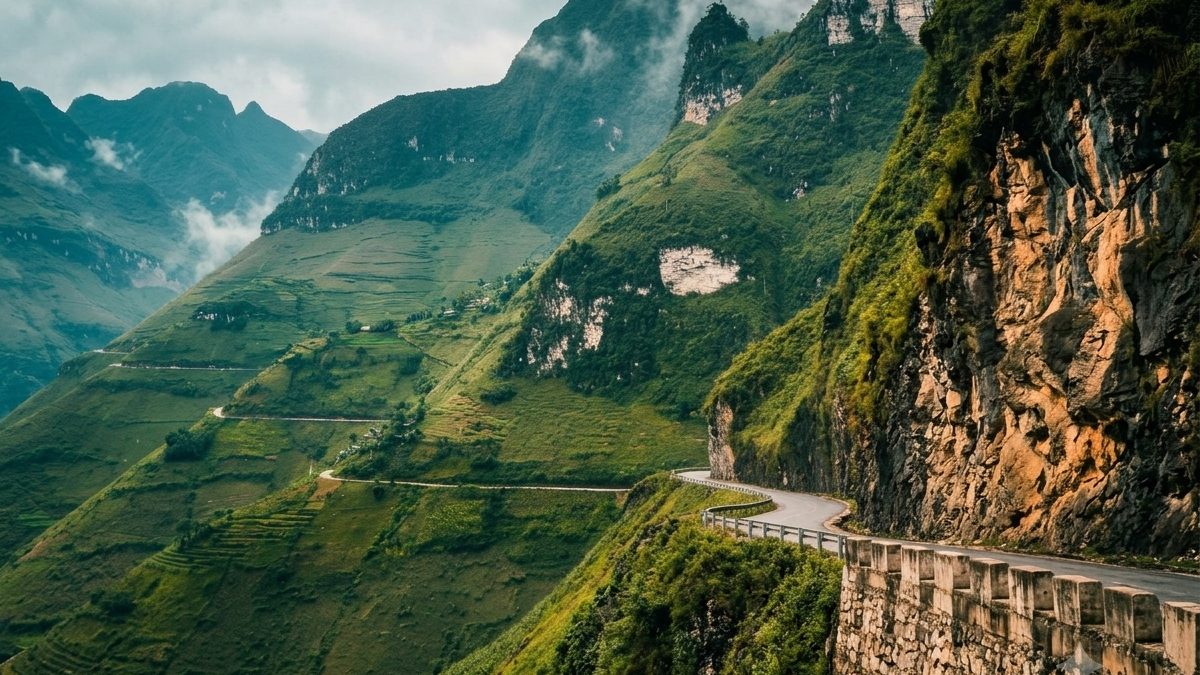
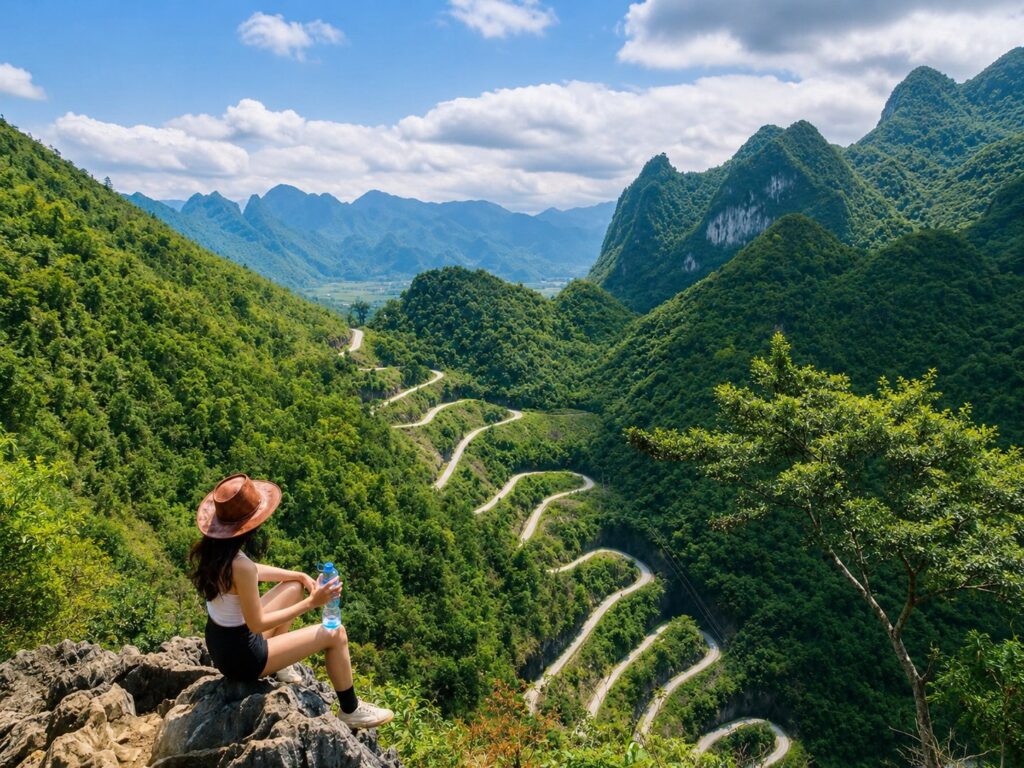
Khau Coc Cha Pass is a 2.5 km stretch of National Road 4A in Cao Bang province, between the market town of Bao Lac and Xuan Truong commune, where the road folds back on itself 14 times and stacks 15 tiers of tarmac up a single mountainside. There is no ticket, the lookout is reached by a steep walk of roughly 1 km from the top of the pass, and on a clear day all 15 tiers fit into one photo. On our Ha Giang to Cao Bang tours it is the highlight of the long transfer day between the Dong Van plateau and Pac Bo.
We are a licensed international tour operator (licence 08-0007/2025/CDLQGVN-GP LHQT) based in Ha Giang city, and Khau Coc Cha Pass sits on five of the routes we run east into Cao Bang. This guide covers where the pass is, how the road came to look like a staircase, which of our tours cross it and on which day, what the viewpoint walk involves, whether you should ride it yourself, and when fog will hide the whole thing. If you are still deciding whether to carry on east after the Loop, start with our guide to extending the Ha Giang Loop to Cao Bang, then come back here for the pass itself.
Where is Khau Coc Cha Pass?
The pass clings to the flank of Coc Cha mountain on National Road 4A, the road that links Bao Lac, down in the Gam River valley, with Xuan Truong commune on the high ground towards Ha Quang and Pac Bo. Since the administrative merger of 1 July 2025 it lies in the enlarged Xuan Truong commune of Cao Bang province (the former Hong An and Xuan Truong communes of Bao Lac district were combined under Resolution 1657/NQ-UBTVQH15).
That puts Khau Coc Cha Pass in Cao Bang, not Ha Giang. From Ha Giang city it lies on the far side of the Dong Van Karst Plateau: on every itinerary we run you reach it on day 3 at the earliest, after Ma Pi Leng Pass, Meo Vac and Bao Lac. It is not a day trip from Ha Giang, and it is not on the standard 3 or 4 day Loop.
Cao Bang’s provincial newspaper describes the road as one of the most treacherous passes in Northeast Vietnam: only about 2.5 km long, yet bent back on itself 14 times, with a lookout above it from which the whole stack of road can be seen (Báo Cao Bằng, 30 March 2023). Coming from Bao Lac you climb; the small grocery shop and the trail to the lookout are at the top.
Why does Khau Coc Cha Pass have 14 bends and 15 tiers?
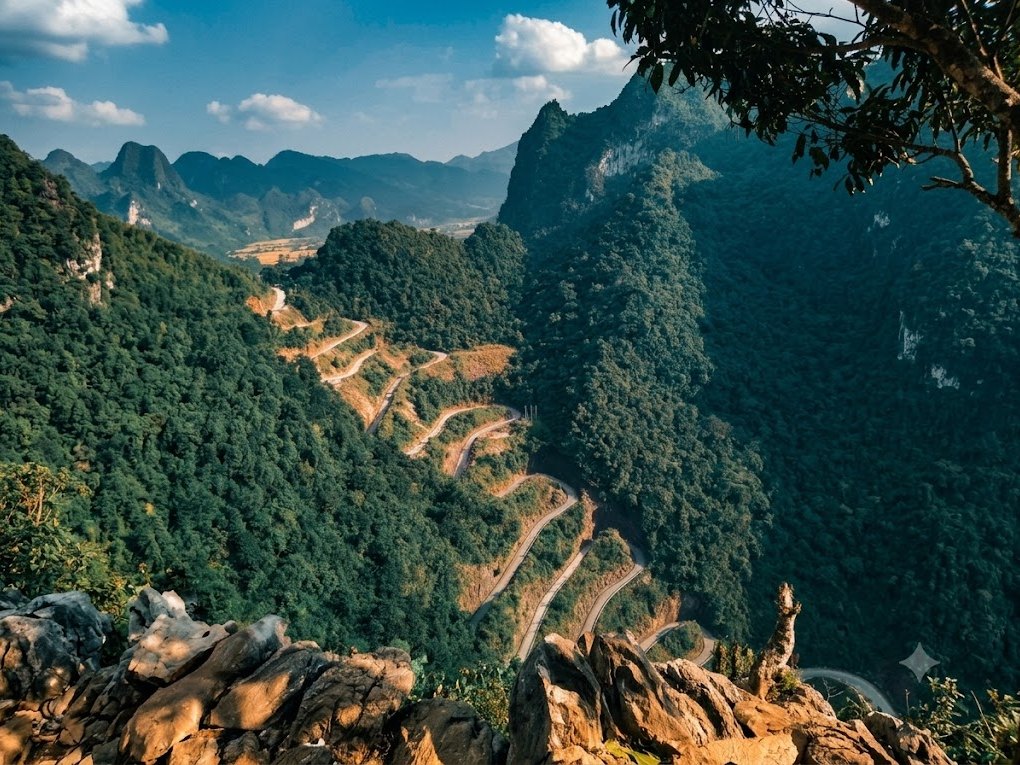
The mountainside under Khau Coc Cha Pass is too steep for a road to climb in a straight line, so engineers ran it back and forth across the slope. Every hairpin turns the road through roughly 180 degrees, and 14 of those turns leave 15 separate levels of road stacked one above the other, which is why the view from above looks like a staircase or a ribbon dropped down the hill.
The road is younger than it looks. Under French rule this was a footpath barely 40 cm wide, used by people on foot and by pack horses. Between 2009 and 2011 Cao Bang province widened it to 5 m and surfaced it; the paved pass opened in 2011 (Nhân Dân, 20 April 2021). Before that, the climb that now takes a few minutes on a motorbike was a half-day walk.
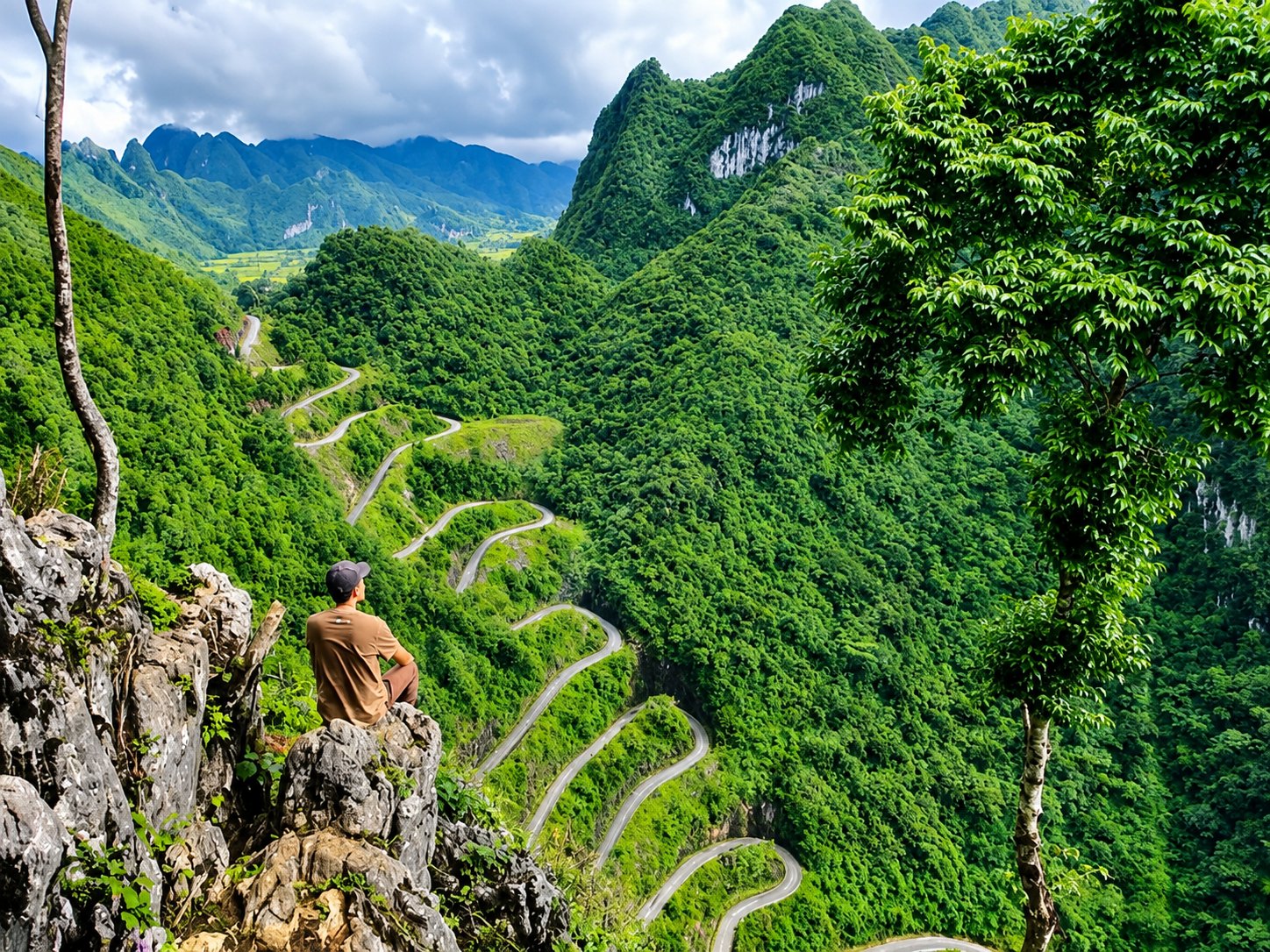
The famous view is not an official platform either. It was Nông Văn Ngoan and Lê Thị Thúy, the couple who run the grocery shop at the top of the pass, who found the spot above the road from which every tier is visible, and who cut the trail up to it. Báo Cao Bằng calls the lookout Pac Thoc. Their shop is still the only place on Khau Coc Cha Pass to buy water or sit in the shade, so it is where every tour parks.
Which Ha Giang to Cao Bang tours include Khau Coc Cha Pass?
Every route we run from Ha Giang into Cao Bang crosses Khau Coc Cha Pass, because National Road 4A is the way from Bao Lac to Pac Bo and Ban Gioc. The pass is never on day 1 or 2: those days belong to the Dong Van plateau. Here is where it falls on each itinerary on our website, with the published prices per person for 2026:
| Tour | Day with Khau Coc Cha Pass | Price from |
|---|---|---|
| Grand North Loop, 5 days | Day 3: Meo Vac → the pass, with a short walk up to the lookout → lunch in Bao Lac → Pac Bo by 14:00 | 10,550,000 VND (about $406), Easy Rider |
| Ban Gioc Traverse, 5 days | Day 3: Khuoi Khon Black Lo Lo village → the pass → Pac Bo, about 120 to 140 km, night at Me Farmstay | 12,050,000 VND (about $463) Easy Rider · 15,350,000 VND (about $590) private car |
| Ha Giang & Cao Bang by Private Car, 7 days | Day 5: 06:30 start from Bao Lac → the pass → Pac Bo → Angel Eye Mountain → Cao Bang city, about 210 km | 19,710,000 VND (about $759) |
| Ha Giang, Cao Bang & Ba Be Lake by Private Car, 8 days | Day 3: 07:00 start from Meo Vac → lunch in Bao Lac → the pass → Pac Bo, about 210 km | 19,590,000 VND (about $755) |
| Sapa to Ban Gioc: The Northern Arc, 6 days | Day 4: Bao Lac → the pass → Pac Bo and the Lenin Stream → Tra Linh, about 140 km | 16,110,000 VND (about $625) |
Prices include 8% VAT, the Ha Giang border permit and travel insurance up to 50,000,000 VND per incident; a deposit of 500,000 VND per guest holds your place and the rest is paid before departure. USD figures are a conversion at 26,000 VND. All of these routes are one-way: they end in Cao Bang city or at Ban Gioc and do not return to Ha Giang, so pack with that in mind. You can compare the full programmes on our tours page or read our Ha Giang Cao Bang itinerary guide for the 5 day versus 7 day decision.
What is the walk to the Khau Coc Cha Pass lookout like?
Park at the grocery shop at the top of Khau Coc Cha Pass. From behind it a dirt trail climbs the hillside to the lookout. Báo Cao Bằng (2023) gives the walk as about 1 km and 30 minutes; the earlier Nhân Dân piece (2021) describes closer to 2 km on foot. Our own experience sits between the two: allow 30 to 45 minutes up, less coming down, on a path that is rocky, steep in places and without railings.
- Shoes: closed shoes with grip. Sandals are fine for the pass itself, not for the trail.
- Water: the shop sells drinks; there is nothing on the trail.
- Knees and heart: the climb is short but steep. If stairs at home are hard work, stay at the road: you still see several tiers from the bends near the top.
- Fog: if the valley is white when you arrive, the walk is pointless. Have a tea at the shop, give it 20 minutes, and go up only if it lifts.
- Rubbish: carry everything back down. The couple who made the trail also keep it clean.
On our Easy Rider tours the walk is part of the programme and the guide goes up with you. On our private-car itineraries the stop is at the pass itself; tell your guide the evening before if you want the full walk to Pac Thoc, so the day’s timing can be adjusted around it.
Can you ride Khau Coc Cha Pass yourself?
Legally, yes, if you hold a motorbike licence that is valid in Vietnam. For most foreign visitors that means an A1 category on an International Driving Permit issued under the 1968 convention; our International Driving Permit guide explains which countries’ permits count. Practically, treat Khau Coc Cha Pass with respect: 14 hairpins in 2.5 km means first or second gear all the way up on a 150 cc bike, engine braking rather than brakes alone on the way down, trucks and buses using the full width of blind corners, and tarmac that is slick for hours after rain.
Three rules from our guides: never stop inside a bend to take a photo, because traffic coming the other way cannot see you until it is on you; keep to your side of the road through every hairpin, even when it looks empty; and if there is fog, slow to walking pace, lights on. Read our honest guide to Loop safety before you decide, and Easy Rider versus self-drive if you are torn.
For what it is worth, we do not sell a ride-yourself option on any route that crosses Khau Coc Cha Pass. Our Cao Bang itineraries are Easy Rider or private car only, partly because the transfer days are long, around 120 to 210 km, and partly because the mountain roads of Cao Bang see far less traffic and far fewer repair shops than the Loop. Pillion with an experienced rider is how most of our guests cross it, and it is also how you get to look at the view instead of the road.
When is the best time to see Khau Coc Cha Pass?
You need a clear sky, because the whole point is to see all 15 tiers at once, and the valley below the Khau Coc Cha Pass lookout fills with fog more often than you would like. In broad strokes:
- October to November: the most reliable clear mornings, dry roads, buckwheat flowers on the Ha Giang side of the route. Our favourite months for the traverse.
- December to February: cold snaps roll in from the north. Khau Coc Cha Pass and the road through Bao Lac can sit near 5°C at dawn, and morning fog is common; by late morning it usually burns off.
- March to May: warm, hazy, with the first rain. Views are softer; the forest is at its greenest in May.
- June to September: the green season, with afternoon storms. We ride the pass in the morning so the hairpins are done before the rain arrives, and the September rice at Ngoc Con further east is the reward.
Our month-by-month Cao Bang weather guide goes into detail, including when the bamboo rafts run at Ban Gioc and when the Thang Hen lakes vanish into grass.
What comes before and after Khau Coc Cha Pass on the route?
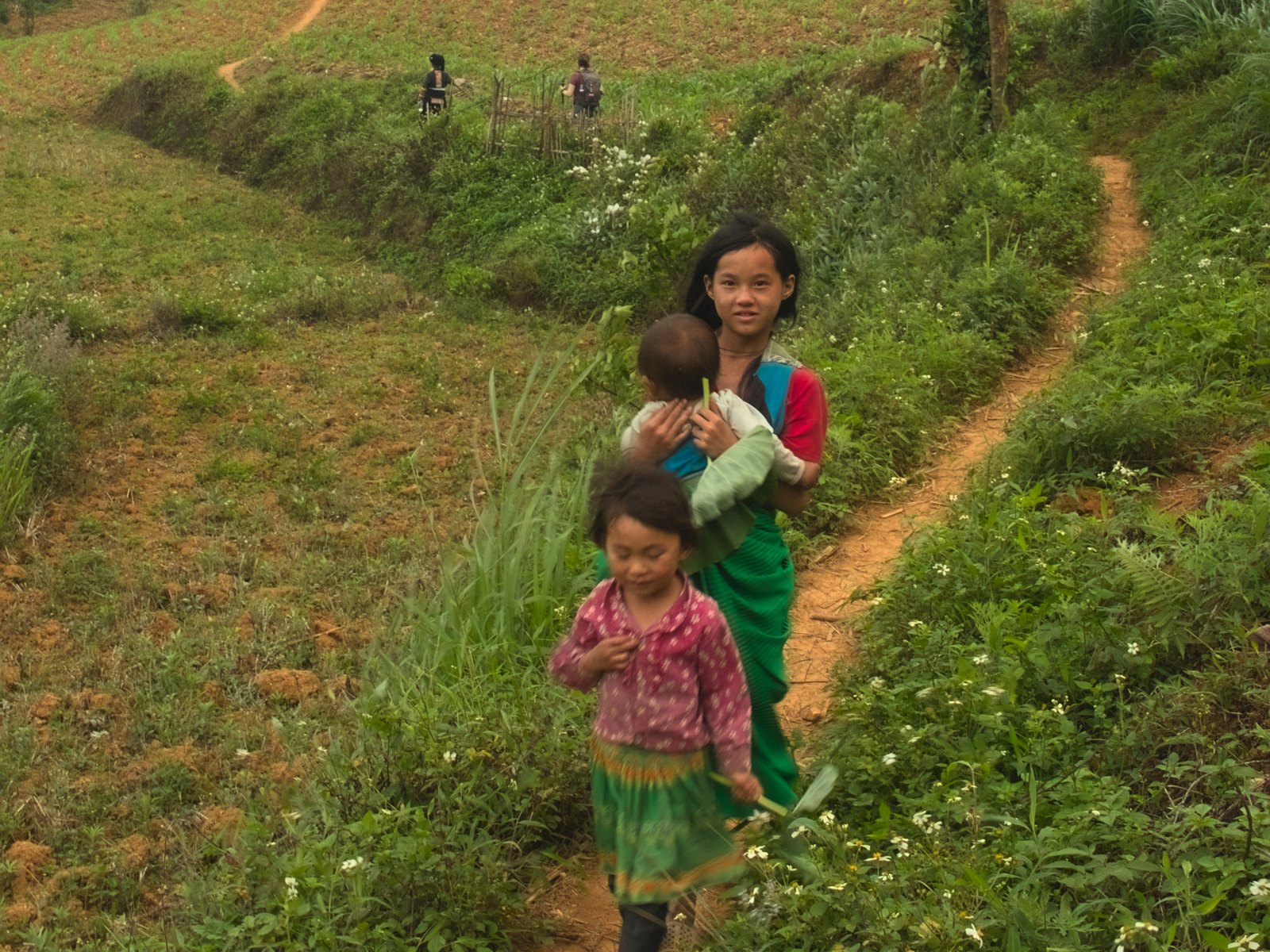
On the Ha Giang side, the day before is the big one: Lung Cu, Dong Van, Ma Pi Leng Pass and the Nho Que River boat, with a night in Meo Vac. From Meo Vac the road drops to the Gam River and follows it through Bao Lam, the first town in Cao Bang, to Bao Lac. On the Ban Gioc Traverse we leave the highway here for Khuoi Khon, a hamlet of about 60 households, all Black Lo Lo, 16 km up a mountain road from Bao Lac. The stilt houses have been restored, the community house keeps bronze-drum models and looms, and the evening ends with Lo Lo songs. If you have met the Black Lo Lo of Lo Lo Chai under the Lung Cu flagpole, this is the same people on the Cao Bang side of the mountains.
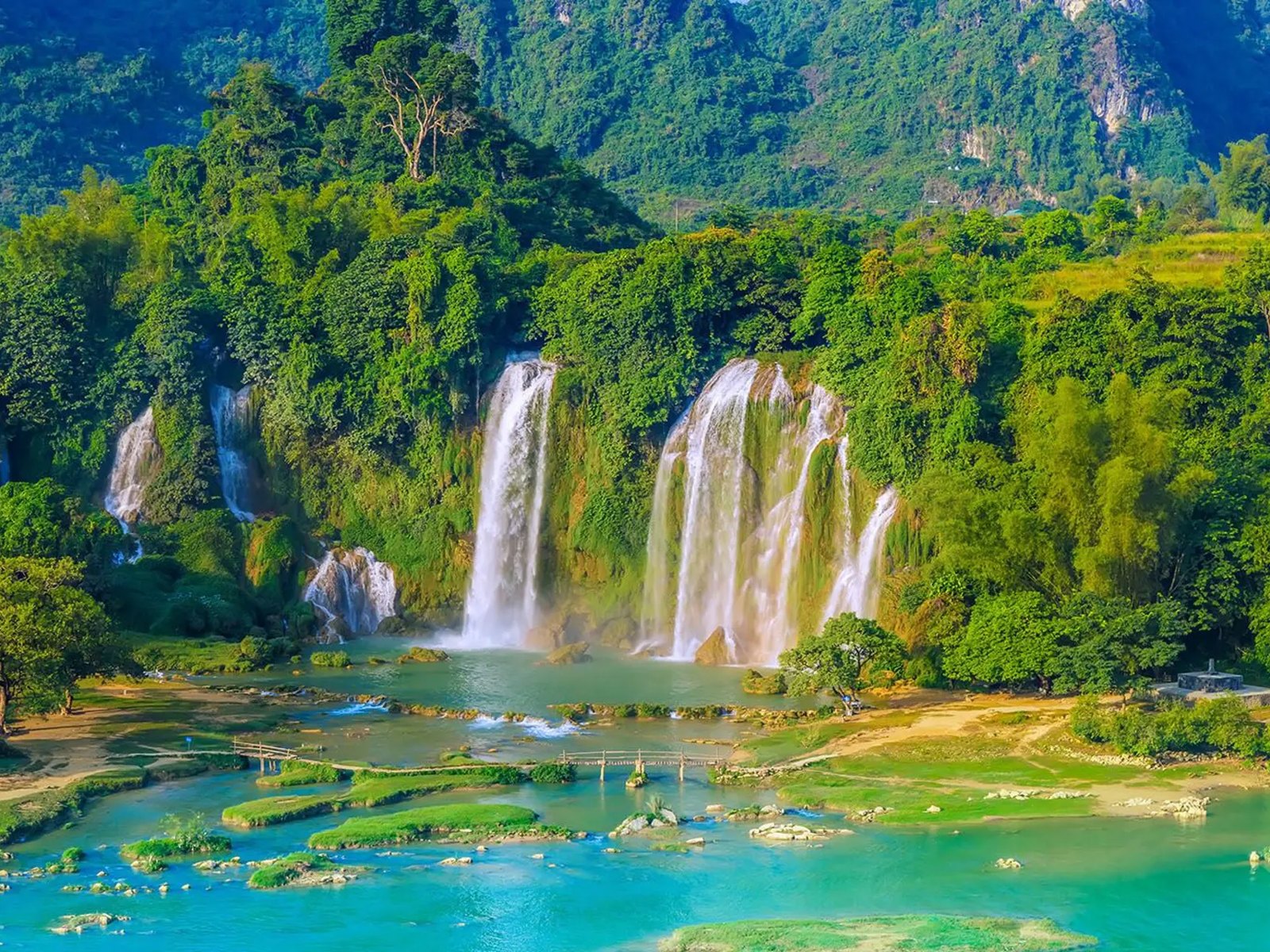
On the Cao Bang side, Khau Coc Cha Pass is the gateway to everything people come to the province for: the Pac Bo historical site with Coc Bo Cave and the jade-green Lenin Stream, Angel Eye Mountain above the Thang Hen lakes, the Tay stone houses of Khuoi Ky, Nguom Ngao Cave, and finally Ban Gioc Waterfall on the Chinese border. Travellers with an extra two days can add Ba Be Lake on the way back towards Hanoi.
Is Khau Coc Cha Pass worth it?
If you are already travelling from Ha Giang into Cao Bang, yes, without hesitation: it costs nothing, it takes about an hour including the walk, and it is the single best view of a transfer day that would otherwise be remembered for its length. It is a different kind of spectacle from Ma Pi Leng. Ma Pi Leng is about scale, a canyon a thousand metres deep; Khau Coc Cha Pass is about geometry, the pleasure of seeing exactly how a road was persuaded up a wall.
It is not worth a dedicated trip. Two full riding days separate it from Ha Giang city, the traverses are one-way, and the bus back from Cao Bang to Ha Giang is a long day on a 29-seat coach. Go because you want Pac Bo and Ban Gioc as well; Khau Coc Cha Pass is the bonus in the middle. And if you arrive in fog, do not take it personally. Our guides have stood at the top with a hundred guests who saw nothing but white, and the shop’s tea is still good.
FAQ: Khau Coc Cha Pass
Is there an entrance fee at Khau Coc Cha Pass?
No. It is a public national road and the lookout trail is free; when our team surveyed the stop in July 2026 nobody was collecting a ticket. The shop at the top sells drinks, which is the polite way to pay for the parking space.
How long is Khau Coc Cha Pass?
About 2.5 km of road with 14 hairpin bends, forming 15 tiers. Riding it takes only a few minutes at a safe pace; the stop and the walk up to the lookout are what take the time, so allow roughly an hour in total.
Is Khau Coc Cha Pass the same as Me Pia Pass?
You will see the label “Me Pia” or “Mẻ Pja” on some maps and blogs for the 14-tier road, and Vietnamese sources do not agree: Nhân Dân (2021) treats Mẻ Pia as a separate, lower pass towards Bao Lac, while other articles have used it for the same stretch. We use Khau Coc Cha, the name Cao Bang’s provincial newspaper uses in its 2023 and 2026 reporting, and the day-3 line on our Grand North Loop page that still reads “Me Pia 14-turn pass” refers to this same road.
Can I visit Khau Coc Cha Pass as a day trip from Ha Giang?
No. Khau Coc Cha Pass lies beyond Meo Vac and Bao Lac, on the far side of the plateau, and our itineraries reach it on day 3 or later. The sensible way to see it is as part of a one-way traverse that ends in Cao Bang. If you then need to get back, we sell bus tickets at the operator fare: Cao Bang to Ha Giang on a 29-seat bus is 250,000 VND, and Ha Giang to Cao Bang is 350,000 VND.
How hard is the walk to the viewpoint?
Short but steep: about 1 km and 30 minutes uphill according to Báo Cao Bằng, on a rocky dirt trail with no railings. Closed shoes, a bottle of water and a clear sky are the three things you need. If any of them is missing, the view from the road near the top is a fair consolation.
Which direction do you climb Khau Coc Cha Pass?
On all of our routes you arrive from Bao Lac and climb the 14 bends, which puts the shop, the parking and the lookout trail at the top as you finish the ascent. Riders coming the other way, from Pac Bo or Ha Quang, descend the tiers instead and should rely on engine braking rather than the brakes alone.
Ride Khau Coc Cha Pass with us
Khau Coc Cha Pass is on day 3 of our Grand North Loop and Ban Gioc Traverse, and on the Cao Bang leg of every private-car journey we run east of the plateau. Tell us your dates and whether you would rather ride pillion or sit in a car, and we will send the full day-by-day programme. WhatsApp or Zalo (+84) 787 652 333, email info@hagiangalitravel.com, or browse all tours.
See more: